The site's referral record is not registered; the code, benefits and commercial arrangement in the account-opening guide remain unverified. That unverified entry does not decide what goes in this table, and Binance appears here on the same terms as everyone else. Full disclosure.
Fee structure comparison matrix
Published spot-rate bands by tier, next to the rule that decides which tier you are in. The range is a dated check; your account page remains authoritative.
Read this first
These are rate bands and tier structures checked in August 2026 from each platform's own page, not live quotes. Product, pair, region and promotions can all change the result. Before acting, open the source in the last column and use the current account fee page or order ticket as authoritative.
One brand can have several price lists. OKX's global and US sites are separate entities, and the US side also groups pairs differently. They are labelled separately below rather than reduced to a supposed universal rate.
Platform
Tier
| Platform | Tier | What puts you here | Checked band | What the band includes | Checked | Source |
|---|---|---|---|---|---|---|
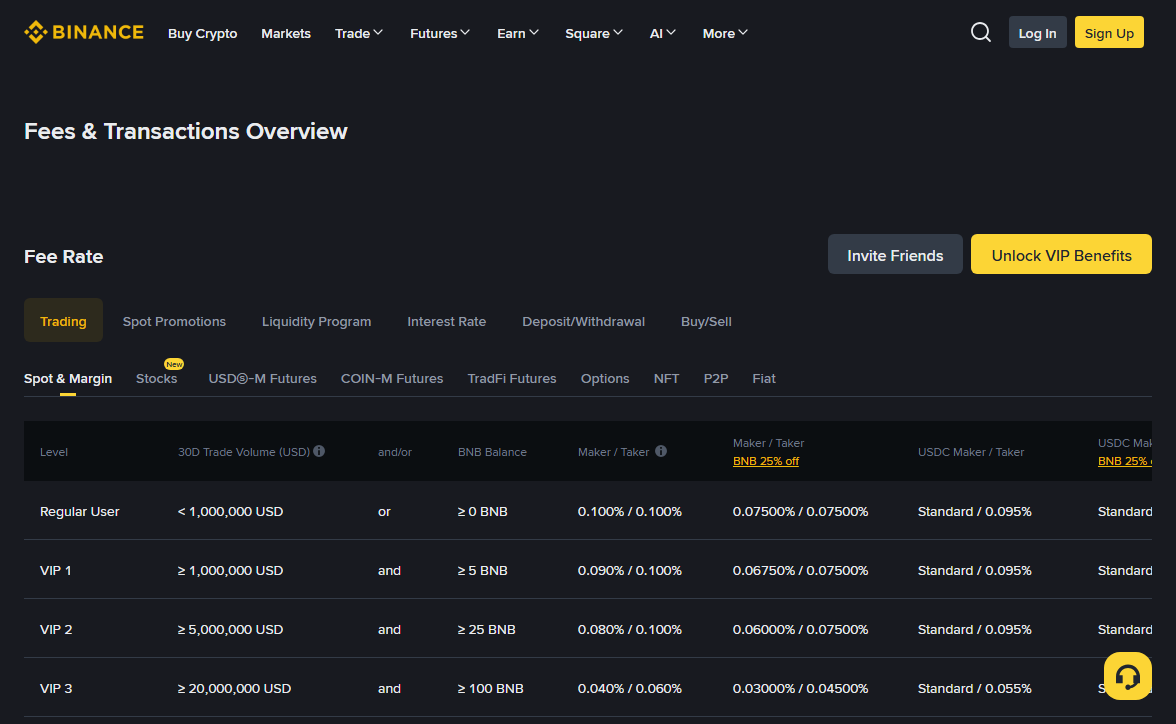
| Binance | Regular User | Does not meet both current VIP volume and BNB conditions | about 0.075%–0.100% | Maker/taker, with or without BNB fee payment enabled | 2026-08 | Fee schedule |
| Binance | VIP 1 | Meets both current VIP 1 volume and BNB conditions | about 0.0675%–0.100% | Maker/taker, with or without BNB fee payment enabled | 2026-08 | Same source as above |
| Binance | VIP 2 | Meets both current VIP 2 volume and BNB conditions | about 0.060%–0.100% | Maker/taker, with or without BNB fee payment enabled | 2026-08 | Same source as above |
| Binance | VIP 3 | Meets both current VIP 3 volume and BNB conditions | about 0.030%–0.060% | Maker/taker, with or without BNB fee payment enabled | 2026-08 | Same source as above |
| OKX (global) | Regular user | Assets and 30-day volume both remain below current VIP 1 thresholds | about 0.0800%–0.1000% | Standard-group maker/taker; other pair groups can differ | 2026-08 | Fee tiers |
| OKX (global) | VIP 1 | Assets or 30-day volume meets the current VIP 1 threshold | about 0.0675%–0.0800% | Standard-group maker/taker; other pair groups can differ | 2026-08 | Same source as above |
| OKX (global) | VIP 2 | Assets or 30-day volume meets the current VIP 2 threshold | about 0.0600%–0.0700% | Standard-group maker/taker; other pair groups can differ | 2026-08 | Same source as above |
| OKX (global) | VIP 3 | Assets or 30-day volume meets the current VIP 3 threshold | about 0.0550%–0.0650% | Standard-group maker/taker; other pair groups can differ | 2026-08 | Same source as above |
| OKX (US) | Regular user | A separate fee table; not the same legal entity as the global site | varies by pair group | Use the current fee shown on the US trading ticket | 2026-08 | Fee tiers |
| OKX (US) | VIP 1 | Assets or volume meets the current US VIP 1 threshold | varies by pair group | Use the current fee shown on the US trading ticket | 2026-08 | Same source as above |
| Kraken | Entry volume tier | Current lowest cross-platform tier; best of spot volume or assets on platform | about 0.40%–0.80% | Spot maker/taker; geography and pair category can differ | 2026-08 | Fee schedule |
If you compare only the entry rates below, the platforms look worlds apart. That comparison is close to meaningless, because each one decides your tier in a completely different way.
The tier rule matters more than the rate
Binance sets VIP tiers on 30-day trading volume and BNB balance together. Miss either current threshold and you remain in the lower tier no matter how much of the other input you have.
OKX sets it on assets under management or 30-day volume, whichever puts you higher. Someone holding a substantial balance who never trades still moves up. The same person on Binance, trading nothing, does not.
That single word — "and" versus "or" — changes who each platform is cheap for. A buy-and-hold account with a decent balance and low turnover gets a better tier from the "or" rule. A high-turnover account that keeps a small float gets nothing from an asset test and everything from a volume test.
Kraken's current cross-platform schedule uses the better of spot volume or assets on platform. That replaced the older volume-only structure, which is exactly why thresholds should be checked on the live page rather than carried forward from an old table.
One brand, two price lists
The two OKX blocks above are not a mistake. The global and US sites are separate legal entities with separate rules, and the US side also groups pairs differently. One brand cannot safely be reduced to one universal rate.
The pages look nearly identical and the domains differ by one path segment. Opening the global page shows a banner offering the US site; the US site does not mention that the global one is cheaper.
Which one is available to you depends on where you are and which entity can verify you, so this is not a free choice. But it does mean that any article stating a single OKX rate may simply have failed to say which table it copied.
Where the money actually goes
Within a tier, maker and taker can be equal or sit at opposite ends of the published band. They may also fall by different amounts when the tier changes. A tier name alone therefore does not tell you whether the side you use became cheaper.
A market order is normally a taker order; a limit order is a maker order only when it rests on the book. The order type you choose can move your cost more directly than the tier label, but the current account display decides the size of that difference.
This is the least glamorous finding on this page and the one most likely to be worth money to you.
What a token discount really costs
Paying Binance fees in BNB changes the published band, but it is not free money: taking the reduction means holding a volatile asset for the privilege of a fee cut.
The useful calculation uses your own account page. Multiply the displayed difference between the discounted and undiscounted rates by real monthly turnover, then compare that saving with the price risk of the BNB balance kept for fees. The rate, discount and token price can all move, so a hard-coded result here would be false precision.
Checking your own tier
The number in a table like this one is the published rate. The number deducted from your trade is whatever your account is actually set to, which can differ because of promotions, regional pricing, or a referral arrangement attached to your account.
Every platform shows your live tier inside the account, usually under a "fee rate" or "VIP level" heading near the trading screen. That page is authoritative and this one is not. For the walkthrough on finding it, the account-opening guide covers where Binance puts it.
What this table cannot tell you
It covers spot trading only. Futures fees are calculated on notional value rather than executed value, so those numbers are not comparable to these and are not shown here.
It also does not capture the costs that never appear on a fee page: the spread you cross, the slippage on a thin pair, and the withdrawal fee when you move funds out. On small, frequent trades those three together routinely exceed the trading fee.
And it is a snapshot. Every row says 2026-08 because that is when we opened the page and read it. The source link in each row is the only thing here that stays current.