The short answer: the published headline rate is the least important number on an exchange fee page. The maker/taker gap and the tier rule underneath it decide most of what you pay, and both differ far more between platforms than the advertised rate does.
Why this page uses bands
Every number on a fee page can be genuine while still applying only to a narrow set of conditions: legal entity, product, pair group, tier, maker or taker, and any promotion or token-payment setting.
When the official pages were checked in August 2026, those distinctions were already visible. One platform separated token-payment rates, another grouped pairs, and another used spot volume or assets on platform to determine a cross-product tier. Turning one cell into "the platform fee" discards the conditions that make it true.
The table therefore keeps a dated public band and a source link rather than presenting a precise snapshot as a lasting fact. The current fee page inside the account and the order ticket are authoritative.
| Platform | Checked band | What it includes | Boundary | Source |
|---|---|---|---|---|
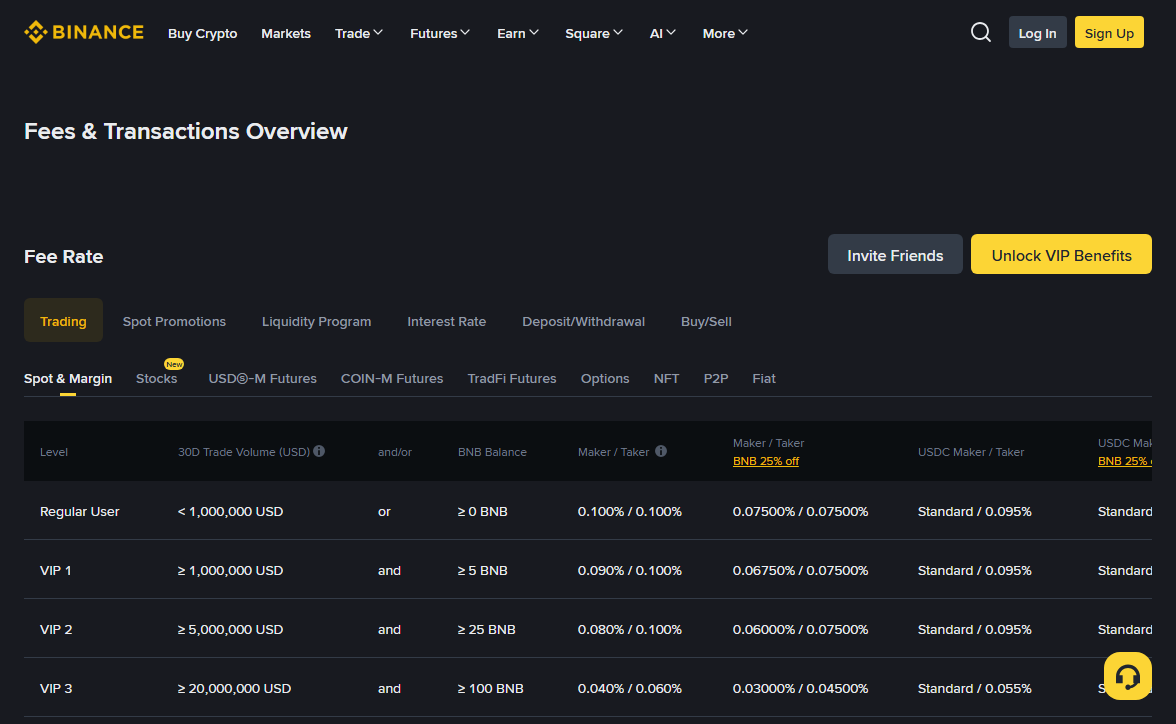
| Binance | about 0.075%–0.100% | Regular-user spot maker/taker, with or without BNB fee payment | Pair, region and promotions can differ | Fee schedule |
| OKX (global) | about 0.0800%–0.1000% | Regular-user standard-group maker/taker | Other pair groups can differ | Fee tiers |
| OKX (US) | varies by pair group | Current maker/taker shown on the US order ticket | Separate entity from the global site | Fee tiers |
| Kraken | about 0.40%–0.80% | Spot maker/taker in the current lowest cross-product tier | Geography and pair category can differ | Fee schedule |
Maker and taker
Every one of these schedules charges two different rates depending on what your order did to the order book.
A maker order adds liquidity. You place a limit order at a price nobody is currently willing to meet, it rests in the book, and someone else eventually trades against it.
A taker order removes liquidity. You place a market order, or a limit order priced so it executes immediately against what is already sitting there.
Platforms charge takers more because makers are doing them a favour. A deep, tight order book is the product an exchange sells; the fee split is how they pay for it. At high tiers on some schedules the maker rate turns negative, meaning the platform pays the maker rather than charging them.
For a retail account the practical consequence is simple and almost never mentioned in comparison content: on any schedule where the two rates differ, your order type changes your cost more reliably than your choice of platform does.
What moves you up a tier
This is where the platforms genuinely diverge, and it is buried in a column most readers skim past.
Binance: volume and token balance, together
Binance's published tier table has a column headed "and/or" sitting between 30-day trade volume and BNB balance. At the regular tier, either side of the condition can keep an account in that tier. Higher VIP rows require both the row's volume threshold and its BNB threshold.
That single word is the whole rule. A token balance alone does not qualify an inactive account for a higher VIP row, and trading volume alone does not qualify an account that misses the matching BNB condition. The live table supplies the thresholds; the durable point is that both conditions apply above the regular row.
OKX: assets or volume, whichever is better
OKX's table has a column for assets under management and another for 30-day trading volume, separated by the word or. Whichever puts you higher is the one that counts.
This is a fundamentally different proposition. It means a qualifying balance you never trade can move you up a tier, while another schedule may require both a balance condition and trading activity. Check the current asset and volume thresholds in the row that applies to your entity.
OKX also notes something easy to miss: if you reach different tier thresholds across different product types, you get the highest tier you have reached. Volume built on one product can pull down your rate on another.
Kraken: volume or assets on platform
Kraken's current cross-platform schedule assigns a tier from the better of 30-day spot volume and qualifying assets on platform. Product category and geography still matter, so the account's fee page is the final check. This is not the old volume-only structure that some comparisons still repeat.
Why this matters more than the rate
Two accounts holding the same amount and trading the same amount can land in completely different tiers on different platforms, purely because one platform counts assets and the other does not. The headline rate tells you nothing about which of those two accounts you are.
The counting period nobody reads
All three use a rolling 30-day window. That is worth sitting with, because it means a tier is not something you earn and keep. It is a status you re-qualify for continuously. A heavy month followed by a quiet one drops you back, and the drop is silent.
The measurement basis also differs by product. Spot volume is generally measured on executed value; futures volume is generally measured on notional value, which for a leveraged position is a much larger number from the same capital. Comparing a spot fee to a futures fee as though they were the same unit is one of the most common errors in this subject, and it is why this page covers spot only.
One brand, two price lists
This is something we hit while checking sources, and it is worth its own section because it invalidates a lot of published comparisons.
OKX's global site and its US site are different legal entities publishing different fee tables. The global table uses standard and other pair groups, while the US order ticket can show a different maker/taker combination for each pair group. A single number cannot represent both entities.
The two pages look nearly identical and the domains differ only by a path segment. Opening the global page shows a banner asking whether you want the US site; which side is cheaper cannot be read off the table above, because the US row only says that rates vary by pair group, so compare the two fee pages for the pairs you actually trade.
Which one you can use depends on where you are and which entity can verify you, so this is not a free choice. An article that states one unqualified "OKX fee" may simply have failed to say which entity, pair group and table it read.
The general form of this is: before you read a fee number, confirm which entity, which product and which tier it belongs to. Missing any of those three makes the number decorative.
What a token discount really costs
Binance's schedule shows a separate discounted column for paying fees in BNB. The percentage and eligibility are platform policy, so copy the current regular and discounted rates from your own fee page before doing the arithmetic.
The discount is real and it is not a trick. The cost is that you have to hold BNB to use it, which means the saving is financed by taking on exposure to a volatile asset you may not otherwise want.
Run the arithmetic with two inputs: monthly turnover and the gap between your account's regular and discounted rates. The monthly saving is turnover × rate gap. Compare that result with the dollar value of the BNB you plan to keep and the loss you could tolerate if its price moves against you.
That comparison changes as volume rises. The fee saving scales with turnover, while the token exposure depends on the balance you choose to hold. This is why the discount can be genuinely useful to an active account and close to meaningless for a light user.
How referral discounts stack
A verified referral arrangement can change a trading fee, but the effect depends on the exchange and what its registration page displays.The account-opening guide on this site carries one Binance referral link with the code BN0112; the site may earn a commission if you register through it (see the disclosure page).
- It attaches at registration and generally cannot be added later (exception: under Binance's Referral Pro FAQ updated in August 2026, an eligible new main account with no deposits, trades or existing referral relationship can request a late binding on the official referral page within 30 days of signing up, subject to identity and risk checks; check the current official rule and never pay a third party to "fix" it). This is the only irreversible decision in the whole account setup process.
- The exchange display is the evidence. A benefit can be changed or withdrawn. Any site quoting a fixed percentage without a current exchange confirmation is overstating what it controls.
- Stacking with a token discount is not automatic. Whether two discounts compound or one supersedes the other is a policy decision the platform publishes. Check it rather than assuming multiplication.
The honest summary is that a referral discount is a modest, real reduction that costs you nothing, applied to a fee that was probably not your largest trading cost to begin with.
Costs that never reach the fee page
The spread. When you take liquidity you buy at the ask and sell at the bid. On a liquid major pair that gap might be a rounding error. On a thin pair it can be several times the trading fee, charged on every round trip regardless of platform.
Slippage. A market order large enough to eat through more than the top of the book fills at progressively worse prices. This scales with your order size relative to available depth, which is why a platform with an excellent fee schedule and a thin book for your pair can be more expensive than a worse schedule with real depth behind it.
Withdrawal fees. Moving crypto off a platform costs a fee set by the platform, not just the network cost. The same asset on different networks can differ by more than an order of magnitude. For someone who deposits, trades once and withdraws, this is frequently the largest single cost of the whole exercise.
Conversion. Depositing in one currency and trading in another introduces a conversion step with its own margin, often built into the rate rather than shown as a fee.
A worked comparison
Take a hypothetical account with 10,000 USD of monthly spot turnover, no platform token and no tier progression. To demonstrate the method without turning a dated platform row into a promise, the table uses illustrative maker/taker bands rather than naming a platform.
| Hypothetical schedule | All taker | All maker | Difference |
|---|---|---|---|
| Equal 0.10% rates | 120 USD | 120 USD | 0 USD |
| 0.10% taker / 0.08% maker | 120 USD | 96 USD | 24 USD |
| 0.35% taker / 0.20% maker | 420 USD | 240 USD | 180 USD |
| 0.80% taker / 0.40% maker | 960 USD | 480 USD | 480 USD |
Three readings come out of this, and they do not all point the same way.
First, a wide rate-band gap is not a rounding difference; it deserves verification against the exact entity and product you can use.
Second, two schedules near the same band may differ by only a modest annual amount at this turnover. That difference should be weighed against liquidity, withdrawal routes and custody controls rather than treated in isolation.
Third, when a schedule has a large maker/taker gap, order type can move the result without changing platform. A resting limit order also carries execution risk, so the cheaper column is not automatically the better trading decision.
Why futures numbers cannot be moved across
This page covers spot only, not because futures are unimportant but because the two sets of numbers are not in the same unit.
Spot fees are charged on executed value: you spend 1,000 USD and the rate multiplies that 1,000. Futures fees are charged on notional value: you post 1,000 USD of margin at ten times leverage, the notional is 10,000 USD, and the rate multiplies that.
So a futures rate that looks like a fifth of the spot rate can cost twice as much from the same capital. The higher the leverage, the larger that multiple. There are also two costs that exist only in futures: funding, paid periodically between longs and shorts, and liquidation-related charges. Neither appears on any fee comparison table.
A workable habit: whenever you see a fee percentage, first establish whether the denominator is executed value or notional value. Comparing two percentages with different denominators is meaningless.
The lever that beats platform choice
This is the finding that comparison content, including this site, has a structural incentive to bury. Sites that compare platforms are usually paid when you open an account, so "which platform" is the question they are built to make feel decisive.
For most retail-sized accounts it is not the biggest lever. Roughly in order:
- Trading frequency. Every round trip pays the spread and the fee. Halving your number of trades halves both, on any platform, under any tier.
- Order type. On any schedule with a maker/taker gap, resting limit orders cut the fee. The cost is that a limit order may not fill, which is a real trade-off and not a free lunch.
- Platform and tier. Meaningful, especially at the extremes, and worth getting right once.
- Token and referral discounts. Real, small, and worth taking if they cost you nothing.
The reason for that order is not modesty. It is that the first two are available to you today, on the account you already have, and the third requires migrating.
Checking it for yourself
Everything above is a snapshot taken in August 2026 from published pages. Fee tables change, and a comparison site is stale the moment one of them does.
- Open the platform's own fee page and find the entry-tier row. The source links in the tables above go straight there and carry no code.
- Open your account's fee rate page. It shows what your account is actually set to, including promotions and referral arrangements that no public table reflects. Where the two disagree, your account page is correct.
- Read the tier condition column, not just the rate column. If it says "and", you need both. If it says "or", you need either. That word is worth more than the two decimal places next to it.
Our own dated snapshot of all three schedules, filterable by platform and tier, is in the fee comparison matrix.
Questions
Why do exchange comparisons often quote one headline rate when the schedules differ?
A headline rate usually comes from one specific point on one table: one entity, one product, one tier and one discount setting. The actual rate depends on which side of the order book you were on, which tier your account sits in, and whether a token discount is active.
Is a maker order always cheaper than a taker order?
On the dated public bands compared here, the maker rate is equal to or below the taker rate. The size of that gap varies by entity, product, pair group and tier, so confirm it on the live account fee page before choosing an order type. A maker order can also fail to fill.
Does holding a platform token actually save money?
It reduces the fee, and it also requires you to hold a volatile asset. Whether that is a saving depends on how much you trade relative to how much of the token you must hold. For small monthly volumes the price risk on the token position is usually far larger than the fees the discount removes.
Which costs are not shown on an exchange fee page?
The spread you cross when you take liquidity, slippage on thin pairs or large orders, the withdrawal fee when you move funds off the platform, and the conversion cost if you deposit in one currency and trade in another. On small frequent trades these routinely add up to more than the trading fee.
How do I find the fee rate my own account is actually on?
Every major platform shows it inside the account, usually on a fee rate or VIP level page reachable from the trading screen. That page reflects promotions, regional pricing and referral arrangements attached to your account, none of which appear in a public table.