A fee page can print 0% and still leave three questions open. Which side of the trade is free, the order that sits on the book or the order that hits it? Does the volume you trade there still count toward your fee tier? And how long is the zero meant to last? Binance, OKX and Bitfinex answered those three questions differently on their own pages in October 2026, and the answers matter more than the headline number.
Zero maker, zero taker, or zero for some tiers only
Open the Spot Promotions tab on Binance's fee overview and the Stablecoins tab on OKX's fee page side by side, and the same 0% turns out to mean three things.
- Both sides free. FDUSD/USDT on Binance; PYUSD-USDT and USDC-USDT on OKX.
- Maker free, taker charged. On OKX, RLUSD-USDT and USDG-USDT carry a 0.0500% taker fee, and so does the USD pair listed beside them. On Binance, BTC/FDUSD, ADA/FDUSD and a long run of other FDUSD pairs show 0% for the maker and the words “Standard VIP Rates” in the taker column.
- Taker free only above a tier. Binance's U Promo sub-tab removes maker fees on its U pairs, and its banner adds zero taker fees for VIP 2–9 users on BTC/U, BNB/U, ETH/U and SOL/U. Scroll the list and a few more pairs, ADA/U and ASTER/U among them, carry the same “0% for VIP2-9” note.
The second and third rows are where people get caught. A market order almost always fills as a taker, so a market buy on BTC/FDUSD pays whatever your tier's taker rate is. For a Binance regular user that read 0.100% on the spot schedule, or 0.075% with the BNB discount switched on. A maker-only zero pays out only if you post a limit order and wait for someone else to trade against it. How platforms decide who counts as maker and who counts as taker is laid out in the fee structures comparison.
Does zero-fee volume count toward your VIP tier?
The rule that decides this gets skipped easily, because it lives in a paragraph under the pair list rather than in the list itself.
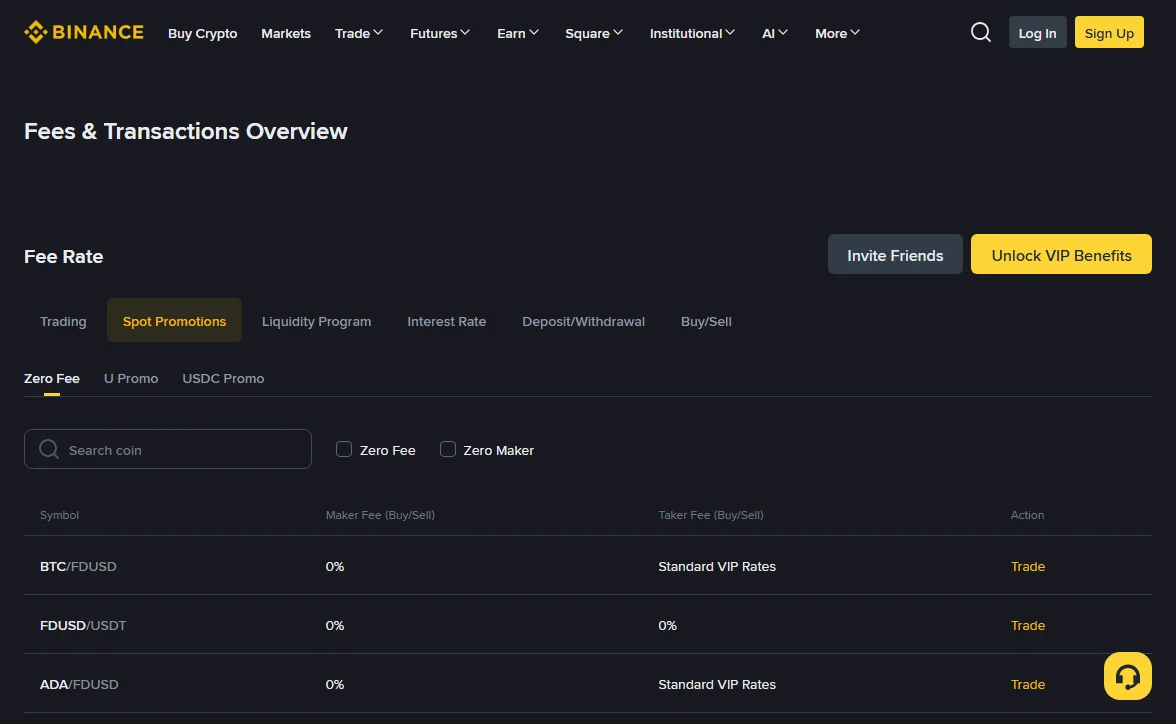
Binance's wording, verbatim: trading volume on Spot and Margin pairs under zero fee promotions (i.e., where zero maker and taker fees apply) will be excluded from VIP tier volume calculation and all Liquidity Provider programs. The next sentence switches off BNB discounts, referral rebates and any other adjustments on that volume. The one after carves out the exception — pairs under zero maker fee promotions are still included in those calculations, where applicable.
OKX draws the line in the same place, under a heading on its fee page about trading tier and market maker programmes: spot pairs with both maker and taker fees at 0% are excluded from the user's 30-day spot trading volume, and excluded from market maker tier assessment. The Chinese-language edition carries the same two sentences under the same heading. Neither edition excludes a pair that still charges a taker fee.
Volume that bought nothing
Suppose you trade $800,000 on FDUSD/USDT and $300,000 on BTC/USDT within 30 days on Binance. VIP 1 asks for at least US$1 million in 30-day volume plus a balance of at least 5 BNB. Your activity adds up to $1.1 million, but only the $300,000 counts, which leaves you $700,000 short. If the stablecoin trading was meant to push you up a tier, none of it helped.
How a zero-fee pair stops being zero
In mid-January 2026 Binance announced that from 29 January, 00:00 UTC, seven spot and margin pairs — BTC, BNB, DOGE, ETH, LINK, SOL and XRP, each against FDUSD — would return to standard taker fees for all users while keeping zero maker fees. From the same moment, volume on those seven pairs counted again toward every user's VIP and liquidity-provider volume.
One notice, two changes. Taking liquidity on those pairs got more expensive, and volume that had been invisible to the tier calculation started counting. Someone watching only the fee column could easily miss that their VIP progress gained a new source that day.
OKX prints its timetable on the fee page instead of leaving it to announcements: pairs are grouped by fee level, the groups and rates are reviewed every three months, and changes are posted on the announcements page at least two weeks ahead. That paragraph appeared on the Chinese-language edition; the Singapore English edition carried the volume rule but not the review cycle. Binance's promotions tab names no review cycle at all, so changes arrive one announcement at a time.
The OKX fee page you see depends on where you open it
For a reader of the English pages, here lies the practical catch. Opening okx.com/fees from our location redirected to the Chinese-language global edition. The English editions are regional, and they publish different schedules: the Singapore page lists a regular-user spot fee of 0.1000% maker and 0.2000% taker with tiers measured in SGD, while the UAE page lists 0.4000% and 0.6000% with tiers in AED. The Stablecoins tab on the Singapore edition showed the same five zero-maker pairs as the global page, with the last one written as USDT-USD.
Each edition ends on the same disclaimer — OKX's fees may vary depending on your region — with a link to the schedule that applies to your account. Treat any OKX figure you see quoted, ours included, as belonging to one edition.
Bitfinex: zero for everyone, other charges unchanged
Bitfinex removed maker and taker fees together in December 2025. Its Zero Trading Fees page says all customers are eligible, with no volume requirements, no token holdings and no tier conditions. Asked whether this is a promotion, the page answers no: an ongoing change, in its words “Zero is the new default”. It covers spot and margin trading, derivatives on Bitfinex Derivatives, eligible products on Bitfinex Securities, and OTC block trades.
The last question on that page matters most once trading is free. Other fees, such as lending and withdrawal fees, remain unchanged. The fee schedule shows where they sit:
- A lender on the margin funding market gives up 15% of the interest earned, or 18.0% when lending through a hidden order.
- A bank wire deposit costs 0.100% of the amount with a 60 USD/EUR minimum; the OpenPayd USD route lists 0.100% with a $30 minimum.
- Withdrawals carry a fee per asset and per network. Tether on Ethereum appears twice in the list: “USDt (ETH)” showed 2.1479 USDt on the day we read the schedule, while “USDt V2 (Ethereum)” showed free. These amounts move with network conditions, so check the exact line you are about to use.
With trading fees at zero, the comparison between venues moves to these lines instead. Why one coin's withdrawal fee can differ many times over between networks is covered in what a withdrawal actually costs, and the withdrawal fee lookup walks you to the right line for a given coin and chain.
The three platforms side by side
| Platform | Volume on both-sides-free pairs | Which side the 0% covers | Where it applies | How changes reach you |
|---|---|---|---|---|
| Binance | Excluded from VIP volume and liquidity provider programmes; no BNB discount on it. Maker-only pairs still count | Three patterns: both sides; maker only; taker free for VIP 2–9 only | Pairs listed on the Spot Promotions tab (Zero Fee, U Promo) | Pair-by-pair announcements, e.g. seven FDUSD pairs regained taker fees on 2026-01-29 |
| OKX | Excluded from 30-day spot volume and from market maker assessment | PYUSD-USDT and USDC-USDT both sides; three more pairs maker only | Five pairs on the Stablecoins tab | Fee groups reviewed every three months, at least two weeks' notice (Chinese-language edition) |
| Bitfinex | No volume tiers left to count toward | Both sides | All spot, margin, derivatives and OTC trading | Described as the ongoing default; lending, deposit and withdrawal fees unchanged |
Four things to read before trading a 0% pair
- The taker column. If it says “Standard” or shows a number above zero, your market orders pay as usual.
- The paragraph under the list. Binance and OKX both put the volume rule there, outside the table. It decides whether this trading helps you reach a tier.
- The quote currency, and the way back out. FDUSD, PYUSD or RLUSD usually has to be converted back to USDT or to cash eventually. Check whether that pair is on the free list too.
- The order book. A zero fee says nothing about price. On a thin stablecoin pair the gap between best bid and best ask can cost a market order more than the fee would have.
For trading that falls outside the free lists, the fee comparison matrix shows how rates move with tier and discount. Whether paying fees in the platform token is worth it is worked through in the arithmetic behind a platform token discount — bearing in mind that Binance switches the BNB discount off on both-sides-free pairs anyway.
How this was checked
The pages below were opened and read in 2026-10; rates, pair names and quoted rules come from them.
- Binance: Trading fee rate (VIP thresholds and regular-user rates); Spot Promotions · Zero Fee / U Promo (pair lists and the volume rule); Binance Updates the Zero Trading Fee Promotion for All Users (2026-01-29)
- OKX: Fees, Chinese-language edition (Stablecoins tab, trading tier and market maker rules, fee group review cycle); Fees, Singapore edition and Fees, UAE edition (regional schedules)
- Bitfinex: Zero Trading Fees (eligibility and FAQ); Bitfinex Introduces Zero-Fee Trading (announcement, 2025-12-17); Fee schedule (lending, deposit and withdrawal fees)
Zero-fee lists change often. If a line here no longer matches the page in front of you, tell us; confirmed changes are logged in the corrections record.